
Rockland County City Directory Holdings
Rockland County city directories are best treated as several local collections rather than one uniform series. The Rockland Room digital collection preserves three route- and village-focused titles, while the Rockland Room’s microfilm shelf adds early Nyack and Haverstraw telephone books, a countywide telephone-book run, and later Cross Reference Directories. The New York State Library directory holdings add a Rockland telephone-book reel for 1933/34. Each title has its own geography, so the book title matters as much as the year.
| Collection | Years | Where Held | Access |
|---|---|---|---|
| Thompson & Breed, Nyack and Northern Railroad of NJ directory | 1889-90 | Rockland Room Omeka collection | Free online |
| Thompson and Breed, Haverstraw villages and West Shore Railroad stations | 1890-91 | Rockland Room Omeka collection | Free online |
| Breed Publishing Company, Seventh Erie Railroad directory | 1904 | Rockland Room Omeka collection | Free online |
| Nyack, Haverstraw, and county telephone books | Nyack 1883-90; Haverstraw 1884-90; countywide 1910-98 | New City Library Rockland Room microfilm shelf | Consult at the library |
| Cross Reference Directories | 1978-99 | New City Library Rockland Room microfilm shelf | Consult at the library |
Gaps are part of the evidence. The documented runs do not establish that every year survives, is digitized, or covers every community. A railroad title may follow stations and business communities instead of town lines. When a surname is absent, check the title’s stated coverage before drawing a conclusion, then ask the Rockland Room or State Library for the precise year or reel.
Note: A missing surname may reflect the title’s limited place coverage or an unheld year, not evidence that the household was absent.
Rockland County City Directories by Railroad Village
Railroads shaped the way many Rockland communities were described in print. The 1889-90 Nyack and Northern Railroad title, the 1890-91 Haverstraw and West Shore Railroad title, and the 1904 Erie Railroad directory each organize places through a route, station, or village setting. That is a useful clue for a historical search. A person tied to a station community may be easier to find by the railroad title, local place name, and surname together than by a broad county search.
The digitized Rockland directories collection is the first online stop for those three titles.
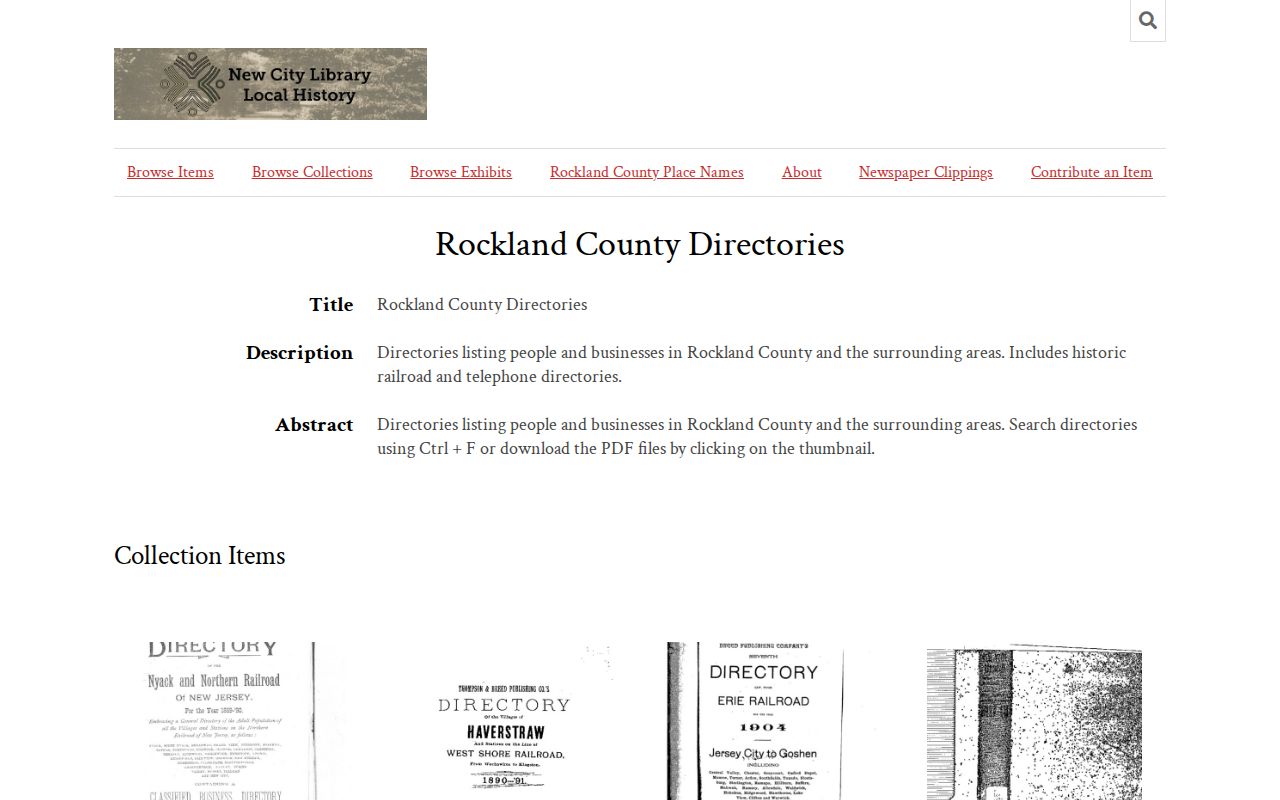
Use the item title and date as a citation note, then inspect the original page before relying on a name, address, or business detail. The collection metadata confirms the books exist, but a page image is the source for an individual entry.
Rockland County Directory Research Room
The New City Library Rockland Room is the central local shelf for historical directories, newspapers, census material, maps, oral histories, photographs, and obituary help. It serves a county-focused collection rather than a general genealogy shelf. The documented Rockland Room schedule is narrower than the library’s general hours, so check the library page before a visit. Joseph Barbieri is identified there as the Local History librarian, and the library asks researchers to use its listed access arrangements for local-history help.
The Rockland Room source page identifies the library’s local-history resources and access schedule.
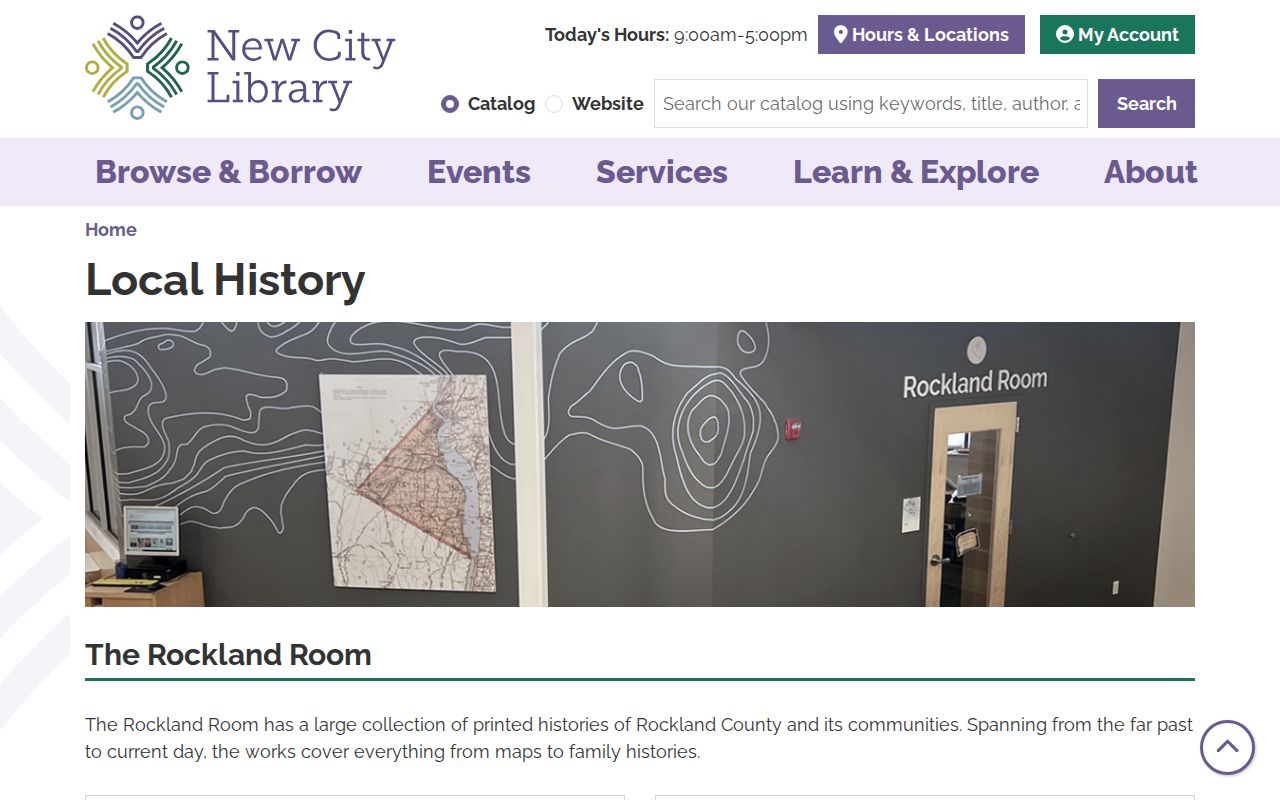
Directories work best alongside the room’s newspaper, obituary, census, and family-history resources. An undigitized catalog entry may still be available in person, while Ancestry Library Edition is documented as an in-library resource and FamilySearch is listed as free.
The shelf also contains the Budke Historical Collection in copied volumes and microfilm. George H. Budke’s original papers are held by the New York Public Library’s Rare Book and Manuscript Division, so the Rockland Room copies are an access path rather than a claim that every original is in New City.
The Genealogical Society of Rockland County, organized in 1985 and sponsored by New City Library, adds a second local route. Its projects copy and computerize church, funeral-home, state-census, and cemetery records, and its reference collection is located at Archives Building S. A cemetery or funeral-home transcription may supply a maiden name, date, or family lead. Confirm an important detail with the cemetery, certificate, obituary, or archival original rather than treating a transcription as the last word.
Reading a Rockland County Directory Entry
Read a city directory entry as a bundle of leads, not a finished identity record. The Rockland research specifically supports recording the printed name, any occupation or business designation, street, house number, spouse or household clues, and nearby entries. Preserve spelling exactly, including initials and abbreviations. A neighboring line can help distinguish two people with the same surname, but it is still a nearby listing rather than proof of family or ownership.
| Printed name | Keep the name as printed, including initials and spelling variants. |
|---|---|
| Occupation or business | Record a designation when the entry includes one; it can guide a newspaper or business-history search. |
| Street and house number | Use the address as a historical lead, then compare it with maps, deeds, and census material. |
| Household clue | Note a spouse, family reference, or other household wording when present. |
| Neighboring entries | Capture nearby printed lines as context, without treating proximity as a relationship claim. |
- Criss-cross directory
- An address-to-name cross-reference directory. Rockland’s documented Cross Reference Directory run is 1978-99.
- Householder index
- A directory arrangement that points to the named household head or household listing instead of a street sequence.
- Abbreviation key
- A key supplied by a particular volume, when present, that explains its shortened labels. Read it before expanding an abbreviation in notes.
Do not assume every Rockland volume has every field or a separate criss-cross section. The documented collection metadata does not provide a page-level sample entry, so cite the scanned page before quoting or interpreting a particular abbreviation.
Note: Keep the volume title and page with each transcription, because the documented collection does not provide a verified sample entry format.
Rockland County Telephone Directory Years
Telephone books extend this historical directory trail into later decades. The county guide identifies Nyack telephone books for 1883-90, Haverstraw books for 1884-90, and countywide telephone books for 1910-98. It separately identifies Cross Reference Directories for 1978-99. These are strong address-and-name bridges, but a telephone listing does not prove property ownership or physical presence on the day a researcher checks it.
| 1883-90 | Documented Nyack telephone-book run. |
|---|---|
| 1884-90 | Documented Haverstraw telephone-book run. |
| 1910-98 | Documented countywide telephone-book run. |
| 1978-99 | Documented Cross Reference Directory run for address/name work. |
| 1933/34 | Rockland County New York telephone-book microfilm lead at the New York State Library. |
For an old street, place the telephone-book year beside the local postal label and municipality. Rockland’s town, village, and postal descriptions can differ. A consistent address across two books is useful chronology, while a changed name or missing listing should be checked against a newspaper, census, or local history source.
Rockland County Household Directory Trail
A household trail should move through time one source at a time. Begin with the earliest volume or telephone book that fits the community, then work forward. Pair directory dates with the census years that bracket them, because a directory can supply an address between census snapshots. When a name changes, retain the old form rather than overwriting it. The goal is a dated sequence of evidence, not a single flat list.
- Choose a Rockland volume whose village, railroad route, or telephone-book coverage fits the family’s known place.
- Copy the printed name, street, house number, and any household or business clue exactly as shown.
- Check the next available directory year and record a move, a spelling change, or an absence without assuming why it occurred.
- Pair the dated listings with the closest census, then compare the address with an appropriate map or deed when needed.
- Use the Rockland Room obituary path, local newspapers, cemetery projects, or the Historical Society to test a disappearance from the directory trail.
Someone can disappear because the book changed scope, the household moved, the line was omitted, or the person died. The Rockland County resident lookup route is better for verifying a modern record, while a historical volume remains a snapshot. Keep the title and page image with every conclusion so another researcher can revisit the entry.
Note: A directory absence should be logged as an absence from that volume, not proof that a person never lived in Rockland County.
Rockland County Newspaper Gaps
Newspapers often fill the years between surviving directory runs. The Rockland Room microfilm includes the Rockland Journal News from 1850 forward, City and Country for 1860 and 1869-1916, the Nyack Evening Star for 1892-1917, and several other county titles. The New York State Library newspaper inventory shows that holdings are divided among several repositories and that title changes are common.
The Historical Society of Rockland County research collection is another route for original documents, artifacts, photographs, maps, and its searchable South of the Mountains PDF run.
Search newspaper indexes by date, town, street, relatives, and events as well as by surname. A notice can clarify why a household changed, but it should be preserved as its own dated source rather than merged into the directory entry.
Rockland County Historical Coverage
Historic volumes in Rockland County are records of how a publisher chose to organize a place. The county was created in 1798, and its river and railroad communities developed distinct newspapers, station references, and business networks. A village, railroad station, postal place, and present municipality may not line up. That is why a title focused on Nyack, Haverstraw, the West Shore Railroad, or the Erie Railroad cannot be expanded into a claim about every Rockland resident.
For modern address-keyed records, use the Rockland County street directory after the historical volume has supplied a street or place. Keep lawful, personal research focused on the record’s stated purpose, and never use historical listings to stalk, harass, or harm anyone.